


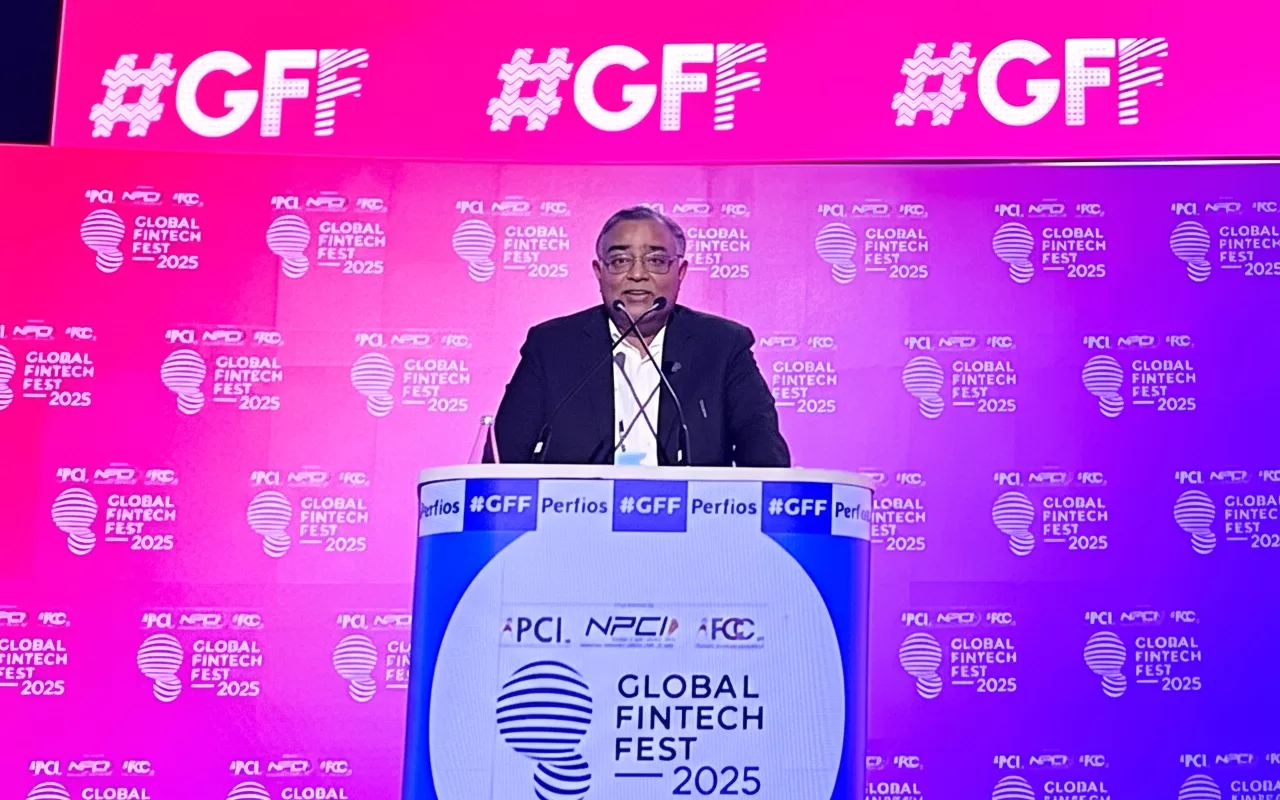
“Artificial Intelligence has transitioned from the periphery to the core of financial innovation. It is redefining how financial services are designed, delivered, and experienced — unlocking new pathways for efficiency, inclusion, and resilience,” remarked Shri Ajay Kumar Choudhary, Non-Executive Chairman and Independent Director, National Payments Corporation of India (NPCI), during his special keynote session at the 6th Global FinTech Fest (GFF) 2025 in Mumbai.
Addressing the theme “AI’s Promise and Peril: Building Responsible Intelligence for Inclusive Finance,” Shri Choudhary emphasised that while AI offers immense potential, it simultaneously introduces challenges that call for prudent governance, ethical frameworks, and international cooperation.
Citing industry projections, he noted that AI investments across banking, insurance, capital markets, and payments are expected to approach USD 100 billion by 2027, with 78% of financial organisations already implementing AI in at least one operational area—up from 55% in 2023. “The debate is no longer about whether AI will shape the future of finance; it’s about how far and how fast we can guide its evolution. The true question is whether we use this power responsibly,” he said.
Shri Choudhary highlighted two major drivers of the AI era — Generative AI, which enables creation and large-scale analysis, and Agentic AI, capable of independently executing complex objectives. Together, these technologies are reshaping fraud detection, compliance automation, precision trading, and customer engagement. Early estimates suggest that global banks could realise productivity gains between USD 200–340 billion annually through these advancements.
However, he also cautioned against the potential downsides of unchecked AI deployment — including model biases, lack of explainability, concentration risks, and structural dependencies spanning the entire AI stack from chips to cloud infrastructure and large-scale foundation models. Global financial watchdogs such as the Basel Committee, IMF, and BIS have all warned that unregulated AI adoption could exacerbate financial cycles and amplify systemic risks.
Highlighting concentration risk as a key concern, Shri Choudhary explained that the AI ecosystem is built on five interlinked layers: specialised processors, cloud platforms, extensive data sets, foundation models, and end-user applications. Currently, one company manufactures nearly 90% of advanced processors, three firms dominate global cloud capacity, and only a few control foundation models. Such concentrated dependencies, he cautioned, can compromise financial stability, economic sovereignty, and even national security. He urged proactive diversification and stronger governance to mitigate these vulnerabilities.
“This is why Responsible AI cannot remain just a catchphrase — it must define our strategy,” he stressed, calling for deeper collaboration among domestic and global stakeholders to enhance data governance, diversify infrastructure, and safeguard systemic resilience in an AI-driven financial world.
Showcasing India’s leadership in inclusive digital innovation, Shri Choudhary referenced the success of Unified Payments Interface (UPI), which now processes over 20 billion transactions each month. He also spoke about NPCI’s initiatives such as UPI Lite for low-connectivity regions, UPI for Her to support women entrepreneurs, and UPI 123Pay for feature phone users.
NPCI, he added, is piloting federated AI models to combat fraud without compromising data privacy, while real-time mule account detection systems are strengthening payment security. The organisation is also expanding its international footprint through NPCI International, promoting sovereign and interoperable real-time payment systems, and extending UPI and RuPay acceptance worldwide.
Among the upcoming innovations, Shri Choudhary announced the launch of Bharat Connect’s Internet & Mobile Banking Platform (IBMB) — designed to standardise merchant payments across online channels — and highlighted NPCI Tech Solutions Ltd. (NTSL) as a dedicated hub for deep-tech research and innovation.
Concluding his keynote, Shri Choudhary underscored the importance of a human-centric approach to AI in finance. “The ultimate test of AI lies in its ability to strengthen stability, not undermine it. It must serve as an instrument of resilience and inclusion, not a source of fragility. The responsibility to shape this balance lies with all of us. With foresight, discipline, and integrity, AI can widen access, deepen trust, and build an inclusive financial future,” he said.
