


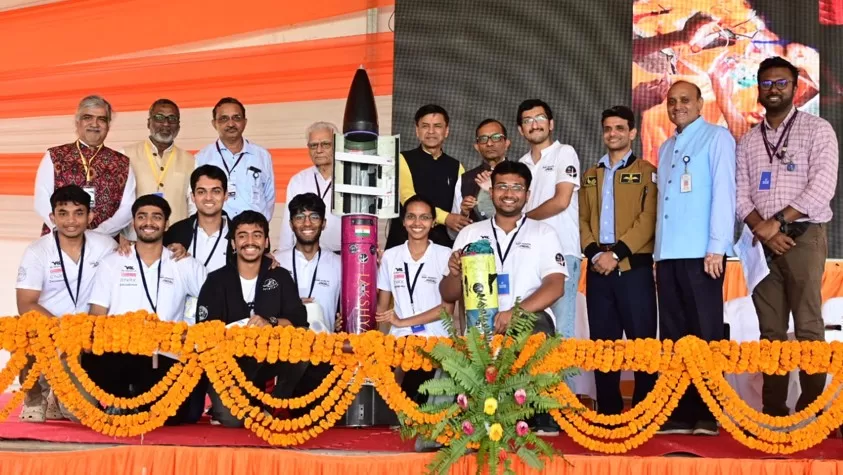
SVKM’s Dwarkadas J. Sanghvi College of Engineering, Mumbai, secured the top position in the CANSAT segment — triumphing among 67 teams from across the country
The IN-SPACe Model Rocketry and CANSAT India Student Competition 2024–25 concluded today on the banks of the Narayani River at Tumkuhiraj, Kushinagar, showcasing India’s brightest student innovators in space technology.
Jointly organised by IN-SPACe, ISRO, and the Astronautical Society of India (ASI) with support from the Government of Uttar Pradesh and District Administration, the four-day national finale brought together 67 teams — 31 in Model Rocketry and 36 in CANSAT — representing leading educational institutions across the country.
A total of 37 successful launches were conducted, with teams evaluated by ISRO and IN-SPACe scientists on design, performance, telemetry, and innovation.
R.V. College of Engineering, Bengaluru, emerged as the national winner in the Model Rocketry category, while SVKM’s Dwarkadas J. Sanghvi College of Engineering, Mumbai, topped the CANSAT segment. Other top performers included Pranveer Singh Institute of Technology (Kanpur), Dayanand Sagar College of Engineering (Bengaluru), Nirma University (Ahmedabad), and BITS Pilani (Hyderabad).
Addressing the closing ceremony, Dr. Pawan Goenka, Chairman, IN-SPACe, said, “This competition reflects the Prime Minister’s vision of nurturing young talent to build India’s future space missions. It’s encouraging to see the passion and precision of our students as they turn learning into real innovation.”
Hon’ble MP Shri Shashank Mani commended the event’s impact, noting that hosting the competition in Kushinagar has “planted the seeds of aspiration in thousands of young minds.”
Dr. Vinod Kumar, Director – Promotion Directorate, IN-SPACe, highlighted that the initiative empowers students to take innovation beyond classrooms and build India’s space future “brick by brick.”
The event also featured a Space Exhibition, attracting over 650 students from nearby districts, and outreach programs such as Art-in-Space and Space Quiz 20:20, which engaged 75,000 students across seven districts.
The competition concluded with a felicitation ceremony celebrating the creativity, technical skill, and dedication of young minds driving India’s next phase of space exploration.
