


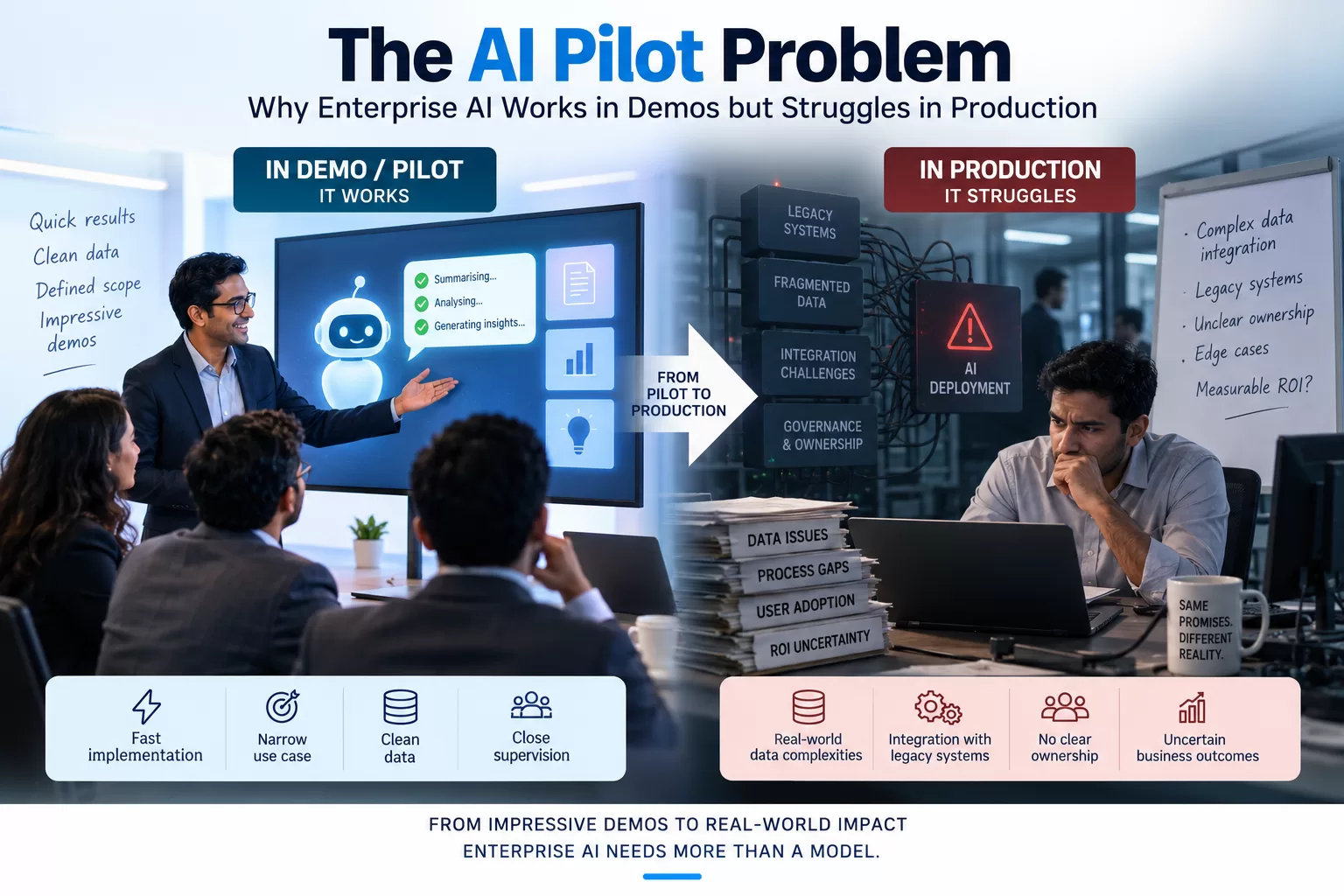
Enterprise AI has no shortage of impressive demonstrations. A model can summarise documents, identify patterns, generate recommendations or automate parts of a business process within weeks. But getting the same system to work reliably inside a live enterprise is proving to be a very different challenge.
The gap between experimentation and production is becoming one of the defining questions around enterprise AI adoption. Industry executives say the problem increasingly has less to do with the capability of AI models and more to do with the environment surrounding them: fragmented data, poorly defined processes, unclear ownership, integration with legacy systems and the absence of measurable business outcomes.
From proving AI works to making it part of the business
Sankalp Saxena, Co-founder & CEO of Signoff, believes enterprises often approach pilots with the wrong starting objective. Rather than designing AI around a specific business problem, organisations can become focused on demonstrating what the technology is capable of.
“A successful demo can show what an AI model is capable of. Production is a much harder test: the AI has to work with real enterprise data, understand business context, integrate with existing workflows and ultimately improve a decision or outcome. The real value of enterprise AI begins when intelligence becomes embedded in the decision-making process, rather than remaining a successful experiment.”
The pilot-to-production handover is emerging as a fault line
Abhijeet Kate, Co-Founder and Principal Consultant at digiCloud Solutions, points to another practical problem: pilots are often developed in conditions that bear little resemblance to production.
Clean data, narrow scope and close supervision can make a proof of concept successful. Once connected to real users, live systems and inconsistent enterprise data, previously hidden problems emerge. Kate says projects frequently stall at the handover stage because responsibility for maintaining and improving the system after the pilot has not been established.
“Most pilots fail because they are built to prove a concept, not to survive contact with a real business process. A demo works because the data is clean, the scope is narrow and someone is watching over it. Production is different. Projects usually stall at the handover point, when the pilot team moves on and there is no clear owner to manage exceptions, retrain the model or handle edge cases.”
AI needs an operating model, not simply a model
Chanakya Bellam, Whole-Time Director at AION-Tech Solutions, similarly sees the transition from experimentation to operationalisation as the point at which many initiatives encounter difficulty.
Moving into production requires reliable data, integration, governance, ownership and a measurable outcome. If responsibility remains divided among business, IT, data and AI teams, a successful demonstration can struggle to become an enterprise capability.
“Enterprises need to treat AI pilots as the first step in a broader transformation rather than as standalone experiments. The objective should be to identify from the outset how an AI use case will fit into an existing workflow, who will own it, how its performance will be measured and what economic value it is expected to create.”
The real AI project may be redesigning the workflow
Aditya Kathotia, CEO & Founder of Nico Digital, takes the argument a step further: the AI model may ultimately be the last piece of the production puzzle rather than the first.
He identifies four characteristics among organisations successfully moving beyond pilots: clear business ownership, tightly defined use cases, continuous feedback and strong data and process readiness.
“They pick one workflow with a high volume of repeatable decisions rather than trying to automate an entire function at once. The deployment is monitored, and retrained or reprompted based on where it actually fails. They treat data and process readiness as the real project, with the AI model itself as the last part of the work rather than the whole of it.”
The challenge becomes even more pronounced when AI moves beyond a controlled environment. Nandagopal P, CEO, Asymmetri; CTO, Gacsym Ventures; and Limited Partner, Arya Ventures, says organisations frequently underestimate how different the conditions surrounding a production deployment are from those of a pilot.
“As a founder and CTO, I see a big difference between building an impressive feature and building a dependable business capability. A pilot asks, ‘Can the AI do this?’ Production asks, ‘Can we trust it, operate it and create measurable value from it every day?’ Many companies answer the first question and underestimate the second.”
