


India’s vehicle financing market is evolving, with rising car prices, changing consumer preferences and wider access to credit shaping borrowing trends, according to TransUnion CIBIL’s Shifting Gears 2026 – Credit Drives Today’s Mobility report.
Between H1 2019 and H1 2026, the average passenger vehicle loan amount increased 49% to ₹8.2 lakh, while the average repayment tenure rose by five months to 62 months. Notably, 51% of borrowers taking higher-value car loans in H1 2026 came from semi-urban and rural India.
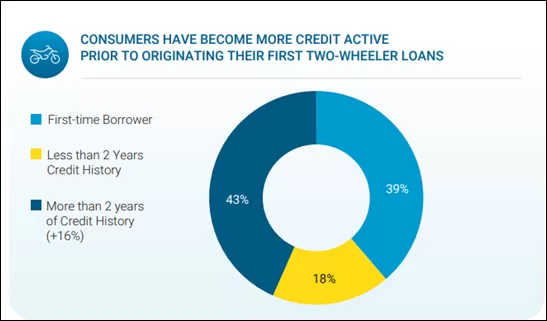
Two-wheeler financing is also attracting more borrowers with established credit histories. In H1 2026, 43% of borrowers had more than two years of credit history, compared with 27% in 2019. Outstanding two-wheeler loan balances reached ₹1.76 lakh crore in June 2026, while the active borrower base grew to 3.3 crore.
Non-banking financial companies (NBFCs) continue to play a significant role, accounting for 73% of two-wheeler loans and 37% of passenger vehicle loans.
Bhavesh Jain, MD & CEO, TransUnion CIBIL, said, “Two-wheelers are closely linked with how young India studies, works and earns. For a student travelling to college, a young professional commuting to work, or someone earning through the gig economy or pursuing an entrepreneurial opportunity, personal mobility can open up a much wider set of possibilities. The borrower behind a two-wheeler loan is also changing. More consumers are coming in with an established credit history, and many continue to build wider credit relationships after the vehicle purchase. Two-wheeler finance is increasingly becoming part of a longer customer journey, with relevance extending well beyond the initial mobility need.”
The report also highlights the growing preference for higher-value, feature-rich cars and the increasing role of formal credit in making vehicle ownership accessible beyond metropolitan markets.
