


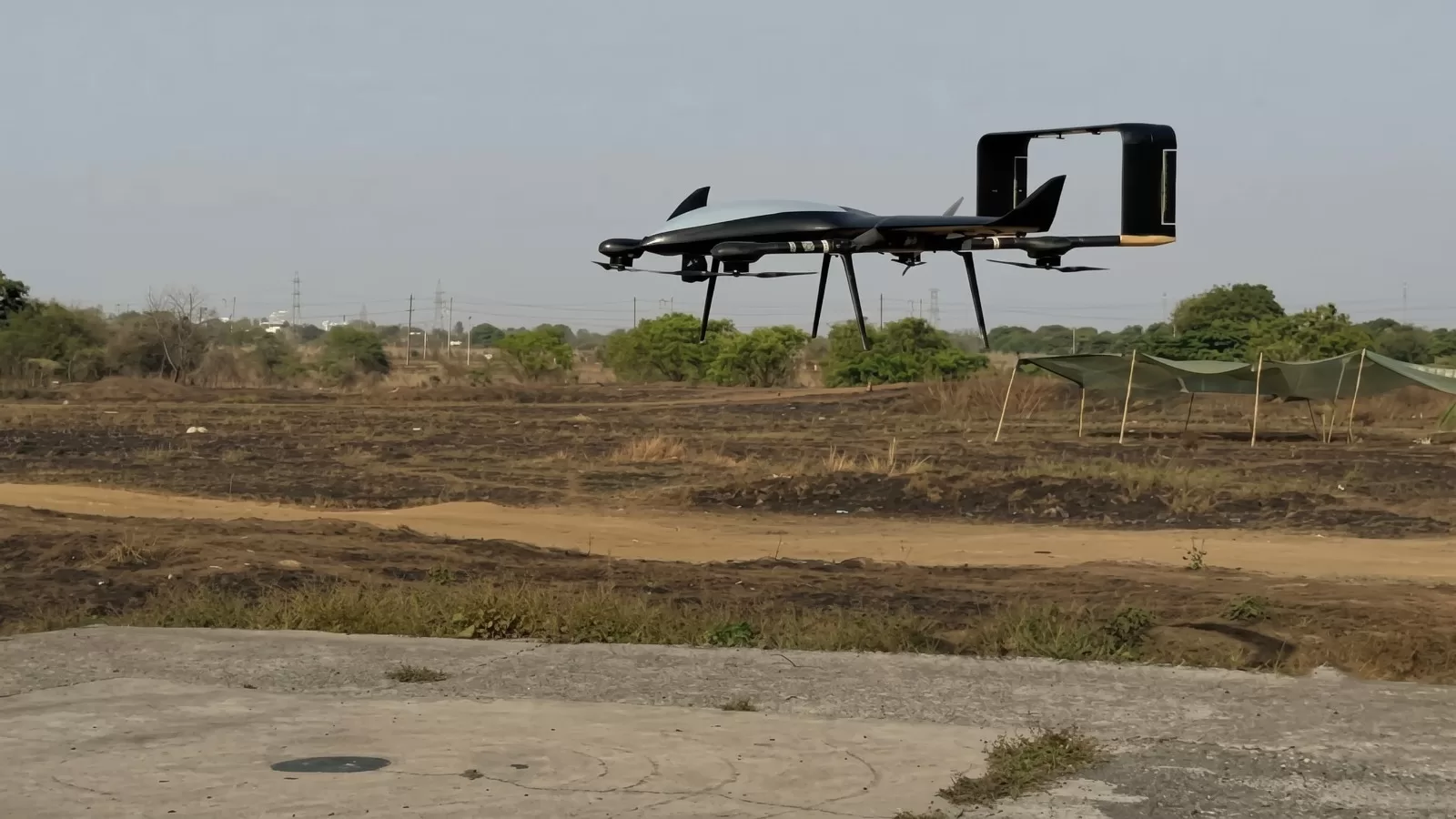
ideaForge Technology Limited has introduced two new variants of its multi-role tactical UAV platform, ZOLT Hybrid and ZOLT Unmanned Combat Aerial Vehicle (UCAV), marking the company’s entry into the long-range ISR and UCAV segments.
The ZOLT UCAV is powered by a battery, while the ZOLT Hybrid combines an IC engine with battery power for extended flight endurance. Designed for day and night operations across varied terrains and environmental conditions, the platforms support tactical missions in Electronic Warfare (EW)-contested environments.
ZOLT incorporates ideaForge’s indigenous EW-resilient technology stack, including Anti-Jam Communications, GNSS-Denied Navigation and Onboard Intelligence. These capabilities are designed to support communication and navigation when signals are disrupted or unavailable, while onboard processing enables decision-making at the edge.
The ZOLT UCAV offers 2–3 hours of endurance, 30–50 km Line of Sight (LOS) transmission and launch capability up to 4,500 m AMSL. The ZOLT Hybrid provides 6+ hours of endurance, up to 100 km LOS transmission and launch capability up to 2,000 m AMSL.
ideaForge is also preparing to introduce a High Altitude variant of the ZOLT Hybrid, designed for contested terrains with launch capability up to 4,000 m AMSL.
The platforms can support border and frontier surveillance, tactical reconnaissance, battlefield and fire-support intelligence, including Direction of Own Artillery Fire (DOOAF), target acquisition and long-range surveillance. ZOLT can also be configured with ideaForge’s NAKSH family of ISR payloads for electro-optical, infrared and MWIR observation, laser ranging and tracking.
Sachin Pukale, AGM – Product Management, ideaForge Technology Limited, said, “The tactical long-range UAV field is evolving from platforms that primarily see the battlefield to systems that can contribute more directly to the mission. With ZOLT Hybrid and ZOLT UCAV, we are extending that capability across different tactical requirements while retaining a common platform architecture and the resilience needed for contested environments. This gives users greater flexibility to balance endurance, reach, and mission needs as operational requirements continue to evolve.”
