


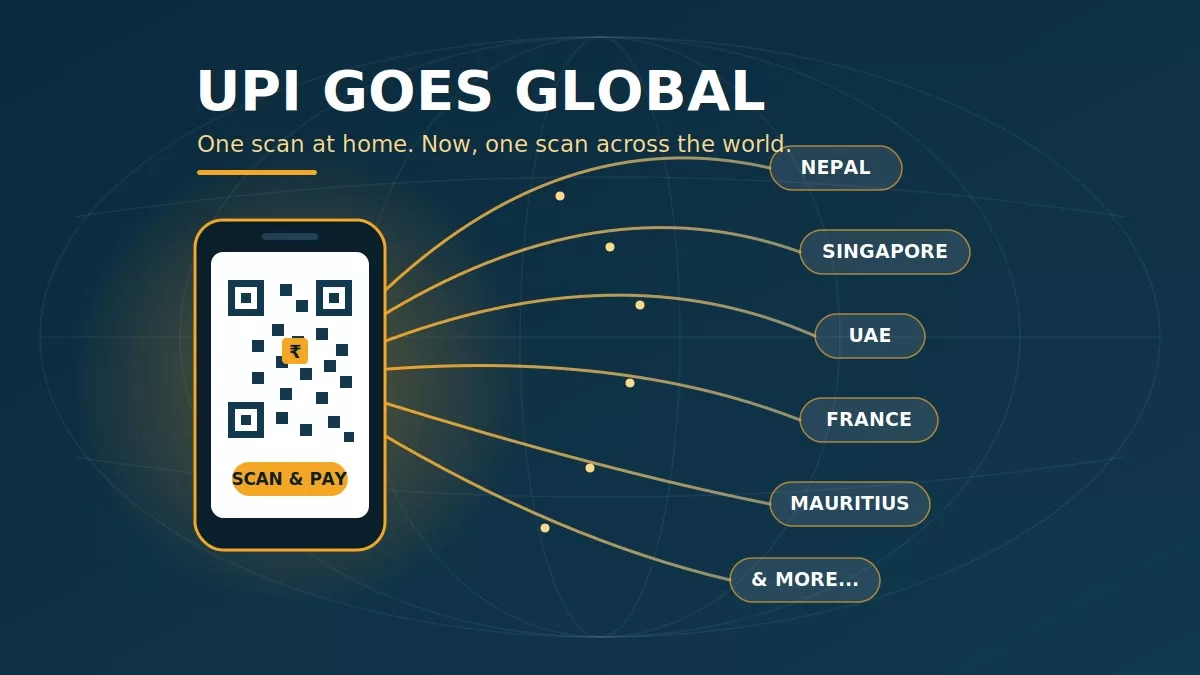
Most Indians no longer think twice before scanning a QR code to pay for tea, groceries or an auto ride. Now, that same simple habit is travelling abroad — and quietly changing how the world moves money.
What is happening?
The Unified Payments Interface (UPI), built by the National Payments Corporation of India (NPCI), lets money move instantly between bank accounts using just a phone. Through its international arm, NPCI International Payments Limited (NIPL), India has been signing deals with banks and payment networks in other countries so that Indian travellers can pay abroad the same way they pay at home.
Today, UPI payments are accepted in several countries, including Bhutan, Nepal, Sri Lanka, Mauritius, Singapore, the UAE, France and Qatar. An Indian tourist can scan a QR code at Dubai Duty Free, a Singapore hawker stall or even at the Eiffel Tower’s ticket counter, and the money leaves their Indian bank account in rupees. The currency conversion happens behind the scenes.
It is not just about tourists
The bigger story is remittances — the money workers send home to their families. India receives more remittances than any other country in the world, yet sending money across borders has traditionally been slow and expensive, often taking days and eating up fees.
UPI is starting to fix this. India’s link with Singapore’s PayNow system allows money to move between the two countries in seconds. More recently, a real-time remittance corridor between India and Nepal went live, connecting UPI with Nepal’s payment network so families receive money instantly instead of waiting in queues. Each new corridor like this puts money back in the pockets of ordinary people.
Why does this matter?
For travellers, it means less dependence on forex cards, cash and currency counters. For small merchants abroad, it opens the door to millions of Indian customers. And for India, every new country that accepts UPI is a quiet diplomatic win — proof that digital infrastructure built for Indians can work for the world.
Agreements with more countries, from Japan to markets across the Gulf and Southeast Asia, are in various stages of discussion. The road ahead has practical bumps — OTPs that don’t arrive on foreign SIM cards, patchy merchant awareness — but the direction is clear.
A payment system designed to help a chaiwala accept ten rupees is now teaching the world how money should move: instantly, cheaply and with nothing more than a phone.
