


ManipalCigna Health Insurance has released South India-specific insights from its India Health Quotient (IHQ) 2026, revealing that 72% of respondents in the region prioritise a healthy, balanced diet, compared with 65% in the rest of the country. The trend is strongest in Bengaluru and Hyderabad, where 75% of respondents identified healthy eating as one of their top five physical health priorities.
The proprietary study assesses self-reported wellbeing across five dimensions—physical, mental, financial, occupational and social—and covered urban respondents across 16 cities, including Bengaluru, Chennai, Hyderabad, Kochi and Coimbatore. While India’s overall health score stood at 65 out of 100, South India recorded 63 out of 100. Physical health emerged as the strongest dimension at 68, while financial health remained the weakest at 62.
The findings also highlight opportunities to strengthen mental wellbeing, with only 49% of respondents reporting strong focus and clarity of mind, while 47% felt confident in their ability to adapt to sudden change.
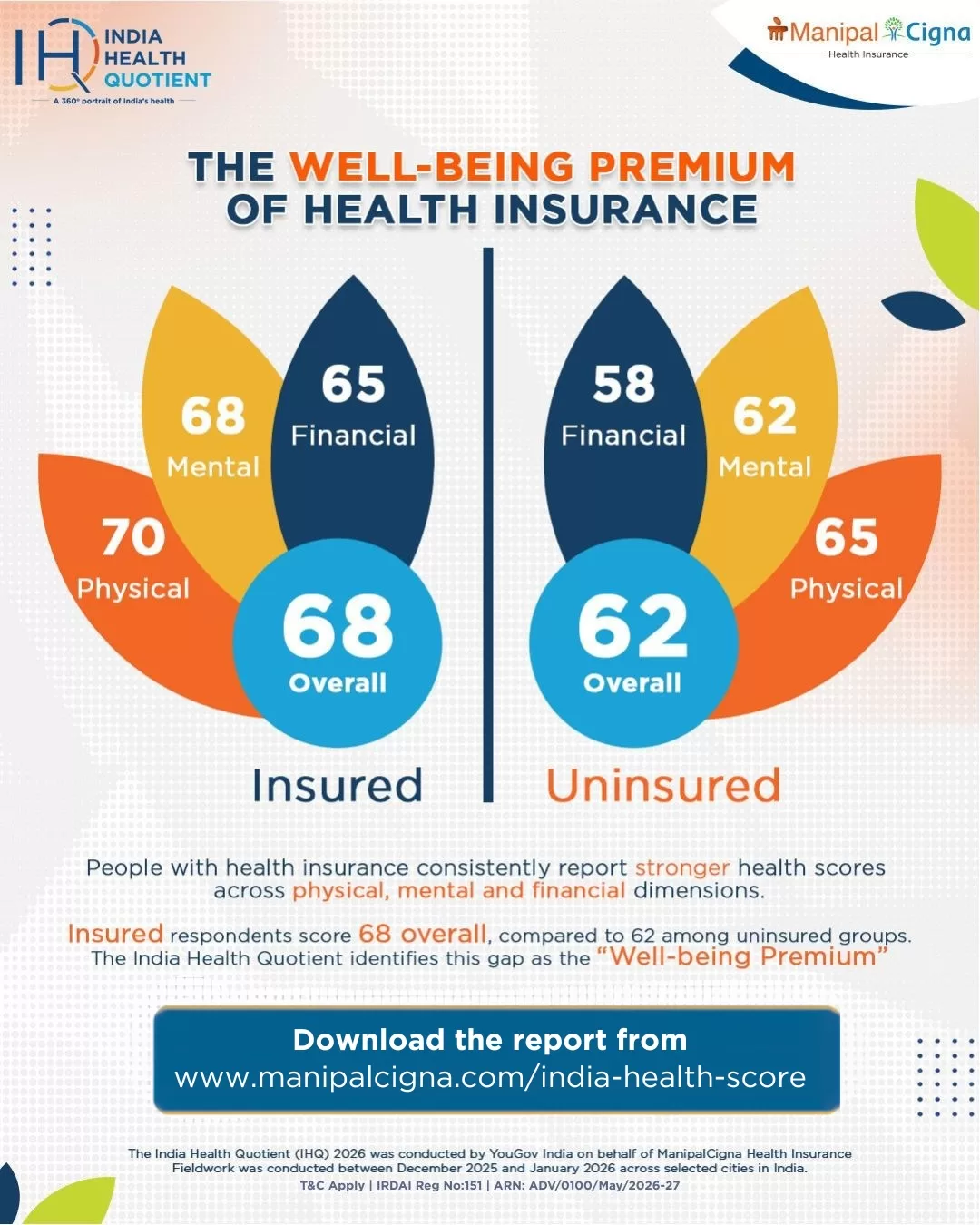
The report further found that health insurance ownership is strongly associated with better wellbeing. Insured Indians scored 68 out of 100 on the India Health Quotient, compared to 62 out of 100 among uninsured respondents. This six-point “wellbeing premium” remained consistent across regions, age groups, genders and stress levels, with insured individuals reporting better physical, mental and financial wellbeing.
Commenting on the findings, Sapna Desai, Chief Marketing Officer, ManipalCigna Health Insurance, said, “The India Health Quotient asks a simple question: how does India actually feel? It shows that health is multi-dimensional, with people balancing physical, mental, financial, and work and social wellbeing, and gaps in one area often affecting the others. South India stands out for its focus on healthy eating, with 72% prioritizing a balanced diet, rising to 75% in Bengaluru and Hyderabad. However, this physical discipline does not fully offset everyday pressures. Across regions, we also see that health insurance ownership helps narrow wellbeing gaps, reinforcing that protection is an important part of overall wellbeing.”
The findings reinforce the need for greater awareness around healthcare financing and financial protection as healthcare needs and medical costs continue to rise, while reaffirming ManipalCigna’s focus on building holistic, evidence-based health solutions for evolving consumer needs.
