

Close Menu
texnxtstorytexnxtstory
  • Home
  • Auto
  • Sectors
    • Technology
    • Business
    • Healthcare
  • Education
  • Interviews
  • Real Estate
  • Thought Leadership
  • Contact Us
What's Hot

AU Small Finance Bank Strengthens Rural Reach with 1,000+ Microfinance Branches

Education in Ireland Fair to Connect Bengaluru Students with 17 Irish Institutions

Flipkart Boosts Ekart Capacity by 50% Ahead of Big Billion Days

Facebook X (Twitter) Instagram
texnxtstorytexnxtstory
  • Home
  • Auto
  • Sectors
    • Technology
    • Business
    • Healthcare
  • Education
  • Interviews
  • Real Estate
  • Thought Leadership
  • Contact Us
texnxtstorytexnxtstory
Home » Blog » Beyond Bengaluru: How India’s Smaller Cities Became the New Tech Frontier
Business

Beyond Bengaluru: How India’s Smaller Cities Became the New Tech Frontier

BureauBy BureauJune 17, 2026Updated:June 17, 2026No Comments3 Mins Read
Share Facebook Twitter Pinterest Telegram LinkedIn Tumblr Email Copy Link WhatsApp
Follow Us
Google News
Illustration: AI-generated for texnxtstory
Share
Facebook Twitter LinkedIn Pinterest Email Copy Link WhatsApp

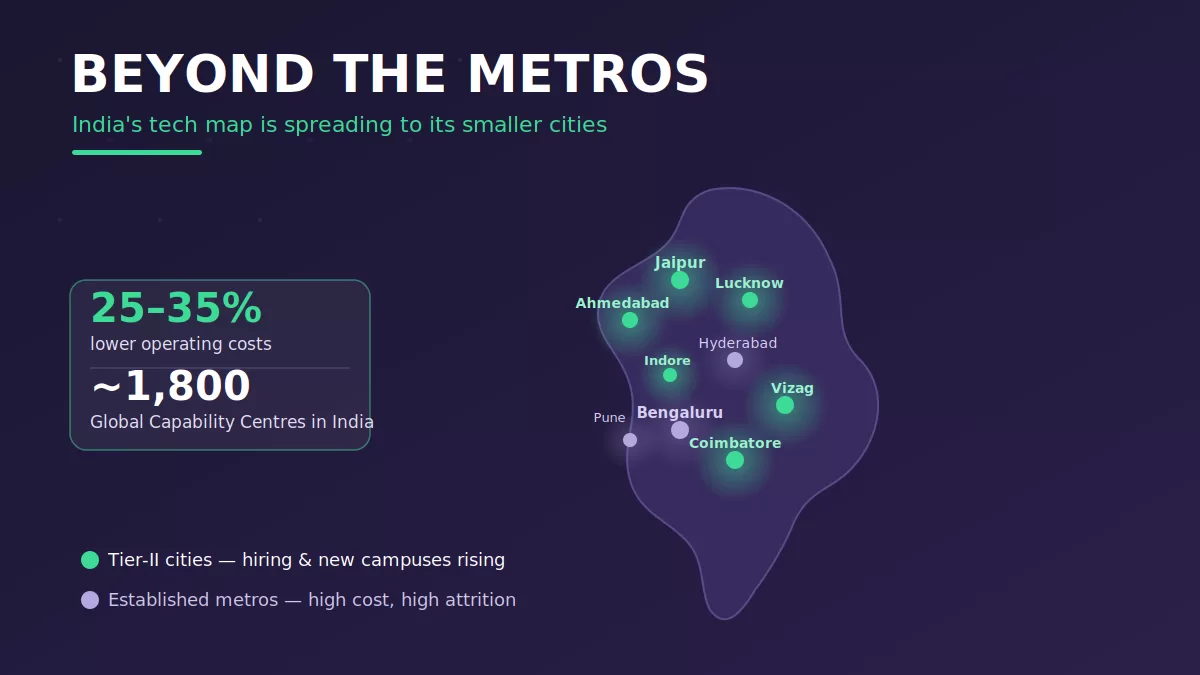
For two decades, India’s technology map had a handful of pins — Bengaluru, Hyderabad, Pune, Gurugram. In 2026, that map is being redrawn. The fastest hiring, the newest campuses and a growing share of high-value engineering work are moving to cities that once sat in the metros’ shadow: Indore, Coimbatore, Jaipur, Visakhapatnam, Nagpur, Ahmedabad and more.

Why the shift is happening

The metros priced themselves out. Years of breakneck growth left Bengaluru and its peers with high real estate costs, long commutes and attrition rates above 15%. Companies running Global Capability Centres — the captive offices that global firms set up in India — began asking a simple question: why pay metro prices for talent that is also available, more loyally, elsewhere?

The answer was Tier-II India. Operating in these cities can cut total costs by 25–35%. Attrition falls too, because employees stay longer when a commute takes 25 minutes instead of 90 and the cost of living is far lower. For employers, that stability is as valuable as the savings.

From back office to brain trust

The most important change is in the kind of work being done. These centres are no longer just call desks and data entry. Companies are placing genuine engineering and research roles in smaller cities — cloud architecture, cybersecurity, AI and product development. Jaipur is emerging as a cybersecurity and fintech base; Ahmedabad is drawing manufacturing and engineering R&D; Visakhapatnam has seen IT hiring leap as large players invest in major campuses.

A popular new model is “hub-and-spoke”: leadership stays in a metro, while scaled engineering and specialist teams sit in Tier-II locations. India now hosts roughly 1,800 GCCs, and the share based in smaller cities keeps climbing.

What is fuelling it

State governments are competing hard, offering capital subsidies, power rebates and skilling funds to attract investment. Better airports, highways and digital infrastructure have closed the connectivity gap. National programmes pushing AI skilling add a steady pipeline of trained graduates who no longer need to migrate to find good jobs.

The honest caveats

The transition is not finished. Senior leadership talent is still thinner outside the metros, and amenities like international schools and healthcare are still maturing. Many Tier-II centres remain second units rather than flagships.

Still, the direction is unmistakable. India’s next technology story will not be written in its biggest cities alone — it will be typed out across dozens of smaller ones.

Follow on Google News Follow on Flipboard
Share. WhatsApp Twitter Facebook LinkedIn Email Copy Link Reddit Telegram
Previous ArticleSony Launches LYTIA L910 CMOS Sensor for Enhanced HDR Imaging and 4K Video Recording
Next Article Apraava Energy Names Rohit Chandak as Director – Finance and Chief Financial Officer
Bureau

Related Posts

AU Small Finance Bank Strengthens Rural Reach with 1,000+ Microfinance Branches

September 29, 2026

Flipkart Boosts Ekart Capacity by 50% Ahead of Big Billion Days

September 29, 2026

Walmart Strengthens Engagement with Andhra Pradesh’s MSMEs, Exporters and Farmers

September 28, 2026
Add A Comment
Leave A Reply Cancel Reply

Advertisement
Latest Posts

AU Small Finance Bank Strengthens Rural Reach with 1,000+ Microfinance Branches

Education in Ireland Fair to Connect Bengaluru Students with 17 Irish Institutions

Flipkart Boosts Ekart Capacity by 50% Ahead of Big Billion Days

Ultraviolette’s Shockwave to Feature New 100V Architecture, Launch in Q1 2027

Trending Posts

Subscribe to News

Get the latest sports news from NewsSite about world, sports and politics.

Facebook X (Twitter) Instagram Pinterest YouTube

Subscribe to Updates

Get the latest creative news from FooBar about art, design and business.

Facebook X (Twitter) Instagram Pinterest
  • Privacy Policy
  • Disclaimer
  • Contact Us
© 2025 texnxtstory.com | Website Developed By Karnatakabest Digital Services

Type above and press Enter to search. Press Esc to cancel.