


Zeta today announced findings from its 2026 CXO survey on AI in Indian banking, based on responses from 40 CXOs across 18 leading banks and NBFCs. The survey finds that AI has moved beyond experimentation, with 70% of CDO respondents placing their institutions at selective or scaled deployment, including 30% at scaled deployment.
AI adoption is strongest in structured, reviewable areas such as retail lending, customer service, fraud and risk analytics, document processing, and software testing. However, integration into end-to-end workflows and consequential decisions remains at an earlier stage.
Security and data privacy have emerged as the leading barriers to scaling AI, scoring 3.89/5, while lack of ROI clarity scored just 2.0/5. Most institutions surveyed allocate less than 10% of new-project technology spending to AI. While 80% of CIOs and CTOs describe their data environments as mostly ready for AI at scale, none consider them fully ready.
The survey also highlights growing focus on AI-led credit-risk models, predictive early-warning systems and real-time fraud decisioning, with at least 60% of CROs identifying these as priorities over the next 18–24 months.
“Indian banks have shown that AI creates value in production. The next challenge is making that success repeatable, and the survey is clear about what stands in the way: not conviction, but control,” said Sivaram Kowta, President, Zeta India.
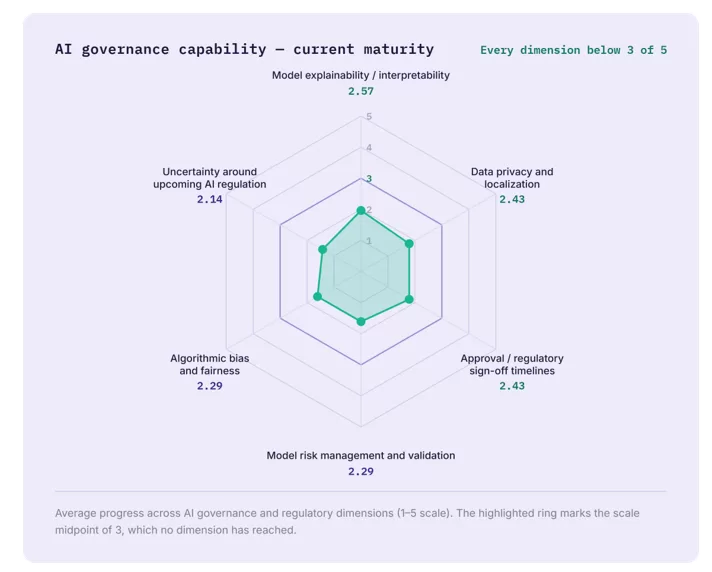
The findings indicate that the next phase of AI adoption will depend on shared data, infrastructure, governance and control capabilities that allow banks to scale successful deployments securely and consistently.
